Why we build campers the way we do
A camper should make it easier to get outside.
That sounds simple, but it guides almost every decision we make. We think about pulling into a campsite after a long drive, getting dressed on a cold morning before hitting the slopes, and packing up when it’s time to head home. A camper might look great in photos, but what matters most is how it works when you’re actually using it. That’s why we focus on campers that are easy to operate, comfortable to spend time in, and practical to carry on a truck.
Building design
We make all of our campers from 1/8" 5052 bent aluminum. It’s lightweight and easy to modify, so you won’t need any special tools if you want to DIY. We chose 1/8" because it’s thick enough to be both the structure and the skin, and it can still be powder coated. Mounting accessories to it is easy.

Tent design
We design our tents around two things: comfort and ease of use. Let’s start with bedding.
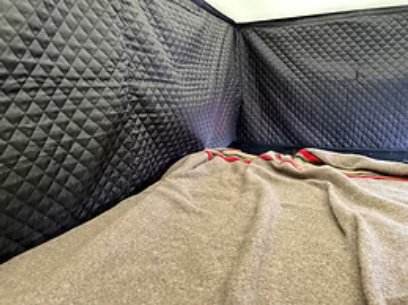
We built a system that lets you store your bedding on a queen-size 4" mattress and still close your camper. We learned why that matters during prototyping, back when we thought smaller was better. It wasn’t. Picture getting to camp after a long day, digging pillows and blankets out of storage bins that eat up a massive amount of space, waiting for them to fluff up, and then going to bed. Recipe for disaster. If you camp somewhere dusty, you track dirt into the truck bed, and when you pull out your bedding you’d better hope it doesn’t hit the ground. Otherwise your bed is now dirty, literally.

That cross-country trip taught us plenty of lessons. The biggest: we won’t compromise on space for bedding.
The second big question is how much room to leave for getting in and out of bed. Some designs leave none. Okay, let’s play that out. Every time you want to get in or out, you have to remove a panel. I don’t know about you, but that’s absurd. Bathroom break? Woke up early for a hot cup of coffee and a sunrise? Stayed up late with friends around the fire, stars overhead, while your wife went to bed? Now you’re deconstructing the bed and trying not to wake whoever was brave enough to sleep next to you. Good luck.
That was a no-go. We found that just under two feet of clearance is the sweet spot: enough room to get in and out easily, and still enough for a queen-size sleep platform.

To make the most of that space, we developed a sliding bed platform that pairs with our 4" memory foam trifold mattress. It takes your camper from sleep mode to full vertical access in seconds. Fold the mattress into “couch mode,” slide the platform out of the way, and suddenly you have a massive amount of open space. Now the camper is ready for the party. You pick the party: a dinner party, a rest-your-feet-after-a-long-morning-on-the-slopes-and-recharge-for-round-two party, or a read-a-book-while-the-rain-softly-bounces-off-the-roof party. Whatever the party, you’ll be there.

And about that queen-size platform, hear me out. When I leave home, I leave behind familiar sounds, familiar smells, and familiar altitude (a big one for us sea-level folks). Out in nature, everything is new. And in that moment I’m supposed to downsize to a 2" mattress and a full-size bed? No way. We wanted comfort. Our goal was to make going from your home to your home on the trails as seamless as possible. The more comfortable you are, the better you sleep. The better you sleep, the more adventures you get to have.
Last up on tent design: how easily it pops up and pulls down. When we designed our first camper, the Bruin, we noticed that wedge campers are simple to open (jack up the struts and they push the camper open), but the full pop-up market was tragic. Roofs seemed to weigh as much as the one on your house. I could never ask my recently retired parents to wrestle one open.
We wondered why nobody showed how easy their camper was to open and close. What we found was that they didn’t show it because it wasn’t easy. It was a degrading process (stay tuned for our blog about add-ons, where I’ll talk about barn doors). First, you crawl under a pop-up back door. In some climates those are great, but they’re not the easiest way to get in and out of a camper. Next, you hoist the roof up with the power of your back and, eventually, your arms. Finally, you make sure it’s locked out.
That wasn’t acceptable. There’s no way we could ask our parents, who worked hard their whole lives and now want to travel, to go through that every time they open their camper.


Our answer was finely tuned gas struts. The hybrid hard-wall system uses a compliant mechanism, which is a fancy way of saying you push the roof up to open it and pull it down to close it. That’s it. For the first few years, our Instagram was filled with customers opening their campers: tall and short, old and young, good shoulders and bad, men and women. All of them did it with ease. My favorite moment is when a couple comes in and the smaller of the two doesn’t want to try. Then they see how easy it is and say, “Let me give it a try,” and just like that, the camper opens and closes with ease.

Base design
Okay, enough about tents. On to our base design philosophy.
We build our bases modular so we can build the camper you want for the truck you have. That means your camper fits your style of camping, you only pay for what you want, and you skip the extras. Build it out from the start, or let it grow with you.
The Weekender is our lightest and most affordable option, a simple starting point for DIYers or anyone who wants to add to their setup over time. The Adventure lets you choose what you want without paying for what you don’t. And the Pro is for those who want to go all out from the start.
We’ll take a deeper look at each package in an upcoming blog. In the meantime, this video walks through the packages:
Still deciding between models? Read our buyer’s guide.
Build the camper you want for the truck you have.